An evidence-based guide to nutrition, cooking, skin care, product quality and the difference between homemade experiments and genuine extracted oil.
An avocado can be mashed into guacamole in minutes. Turning its flesh into a clean, stable cooking oil is another matter. That distinction is easy to miss when videos promise homemade avocado oil from a few ripe fruits and a saucepan. Before trying one of those methods, it helps to understand what is in the oil, what the science supports and why commercial producers use specialized equipment.
What is avocado oil?
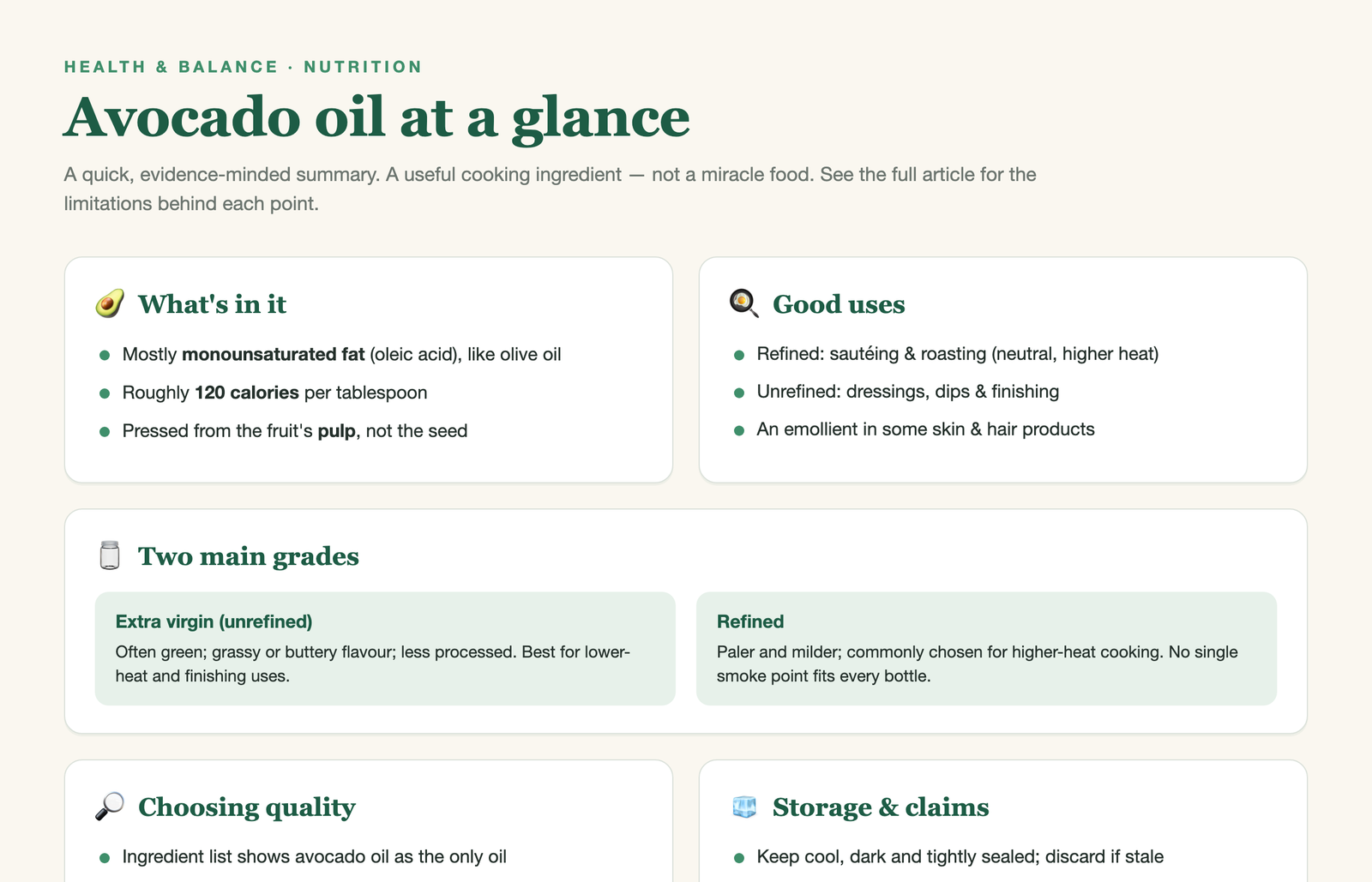
Avocado oil is the fat extracted mainly from the fleshy pulp of the avocado, not from its seed. That makes it different from many vegetable oils, which come from seeds. Its characteristic fatty acid is oleic acid, a monounsaturated fat also found in olive oil. The proportions of fatty acids, pigments and minor compounds vary with the fruit variety, growing conditions and processing method. Extra virgin oil may be green and taste grassy or buttery; refined oil is usually paler and milder.
The distinction between whole avocado and its oil matters. A whole avocado provides dietary fibre and other components of the fruit. The oil provides predominantly fat, and it should not be described as a source of the fruit’s fibre.
What are the nutritional properties?
The main nutritional advantage of avocado oil is its high proportion of unsaturated fat. Replacing foods rich in saturated fat with unsaturated-fat sources can improve LDL cholesterol as part of a balanced eating pattern, according to the American Heart Association. The key word is replacing. Adding avocado oil on top of an already high-calorie diet is not the same as swapping it for butter or another saturated-fat source.
Like other cooking oils, avocado oil is energy dense. A tablespoon of oil provides roughly 120 calories, although the exact amount depends on the measure and product. It is useful as an ingredient, not as a supplement that needs to be swallowed by the spoonful.
Does avocado oil lower cholesterol?
There is a reasonable nutritional explanation for choosing it in place of saturated fats, but the clinical evidence specifically testing avocado oil in people is more limited than marketing often suggests. Studies of people eating whole avocados cannot automatically establish that bottled avocado oil produces the same results. For example, a systematic review of avocado consumption found some improvement in total cholesterol, but no significant overall difference in LDL cholesterol, HDL cholesterol or triglycerides across its pooled comparisons; certainty was low to very low. That is a study about avocados, not a direct trial of the oil.
A sensible conclusion is that avocado oil can be one of several unsaturated cooking oils in a heart-conscious diet. It is not a treatment for high cholesterol and it does not replace medication when a clinician recommends it.
What can you use avocado oil for?
Cooking, roasting and dressings
Refined avocado oil has a neutral flavour and is often chosen for sautéing, roasting and other higher-heat cooking. Unrefined oil is more aromatic and can work particularly well in salad dressings, dips or as a finishing oil. There is no universal smoke point for every bottle: refining, oil quality and storage change how an oil behaves when heated. Do not keep heating oil after it smokes or reuse repeatedly degraded frying oil.
Try one tablespoon in a dressing with lemon juice and mustard, brush a small amount on vegetables before roasting, or use it in a skillet instead of butter when its flavour suits the dish. The amount you use matters more than buying the most expensive bottle.
Skin and hair
Avocado oil is also sold in moisturizers and hair products. Its oily texture may help soften dry skin and reduce moisture loss, but laboratory findings about individual compounds should not be presented as proof that plain avocado oil treats eczema, heals wounds or stimulates hair growth in humans. Clinical evidence for those specific claims is limited. If you have sensitive or acne-prone skin, test a small area first, stop if irritation develops and avoid putting unverified homemade preparations onto broken skin.
How is real avocado oil produced?
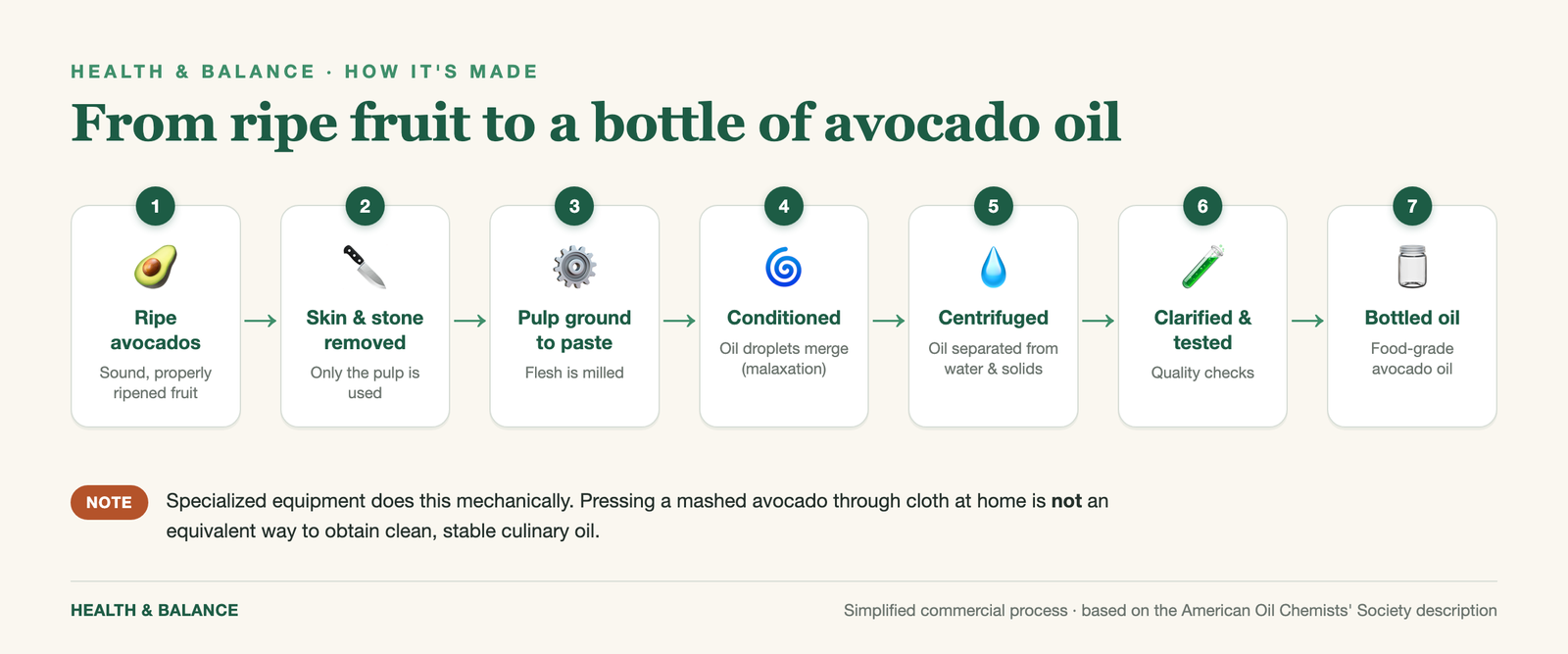
Commercial extraction begins with sound, ripe fruit. Producers remove the skin and stone, grind the pulp into paste and condition the mixture so tiny droplets of oil can come together. Specialized centrifuges then separate the oily phase from water and fruit solids; additional clarification and quality checks may follow. The American Oil Chemists’ Society describes this mechanical process in detail. Pressing a mashed avocado through cloth is not an equivalent way to obtain clean culinary oil.
Can you make avocado oil at home?
You can experiment with recovering some fat from avocado pulp, but calling the result a safe, shelf-stable equivalent of commercially produced avocado oil would be misleading. Home recipes frequently involve blending pulp, heating it until moisture evaporates, and squeezing the residue. These methods produce inconsistent yields and leave uncertainty about remaining moisture, oxidation and contamination. They are not validated food-preservation processes.
If your aim is to learn how extraction works
Use this as a demonstration rather than an edible-oil recipe. Observe how ripe avocado pulp changes when it is crushed and gently warmed, and how oils may separate from wet solids. Do not bottle the collected material for room-temperature storage, advertise it as cold-pressed oil or assume it has the quality of a tested commercial product. For actual cooking, purchase food-grade avocado oil from a reputable supplier.
Why avocado-infused oil is not avocado oil
Pouring purchased oil over avocado pieces or blended avocado creates a mixture infused with fresh fruit, not oil extracted from avocado. More importantly, fresh plant material introduces moisture into an oxygen-poor oil environment. Health Canada warns that improperly handled vegetables and herbs in oil can support the growth of Clostridium botulinum, which causes botulism. There is no validated home shelf-storage method here for fresh avocado pulp in oil. Avoid making jars to keep at room temperature, and do not assume smell or appearance will reveal a food-safety problem.
How do you know whether a bottle is good quality?
A 2023 UC Davis study tested 36 private-label avocado oils sold through retailers in the United States and Canada. Of those samples, 31% met the proposed purity criteria and 36% matched their advertised quality. These percentages describe the specific products tested, not the whole market today. Researchers also found that a higher price did not guarantee purity or quality.
When shopping, check the ingredient list for avocado oil as the only oil if that is what you want, choose packaging that protects the contents from light, and look for a clear producer and best-before date. Green colour alone cannot prove authenticity, and a premium price is not a laboratory test. If oil smells stale, tastes unpleasant or has been improperly stored, discard it.
How should you store avocado oil?
Keep the bottle tightly closed, away from heat and sunlight, and follow the manufacturer’s storage instructions. Buy a size you can reasonably use before quality deteriorates. If it develops an unpleasant stale odour or taste, do not continue using it. Homemade material with uncertain moisture content should not be treated as shelf-stable cooking oil.
Avocado oil or olive oil: which is better?
Neither oil needs to win every comparison. Both are useful sources of monounsaturated fat and can fit into a balanced diet. Olive oil has a particularly extensive body of human research within Mediterranean-style dietary patterns. Avocado oil offers a different flavour and can be convenient for cooking, especially in refined form. Your broader eating pattern, the oil you are replacing, freshness and the quantity used matter more than choosing a fashionable label.
Frequently asked questions
Can I fry with avocado oil?
Food-grade refined avocado oil is commonly used for higher-heat cooking. Use an appropriate temperature, avoid smoking the oil and follow the product label. Unrefined varieties may be better suited to lower-heat uses where you want their flavour.
Can I drink avocado oil for better health?
There is no established need to drink it on its own. Using modest amounts in food is more practical, and adding oil without replacing other calories will increase energy intake.
Does avocado oil grow hair or cure dry skin?
It may act as an emollient in cosmetic products, but strong human clinical evidence for hair growth or treating skin disease is lacking. Persistent skin or scalp problems are better assessed by a clinician.
Can I keep homemade avocado oil for months?
Not on the strength of a social-media recipe. Without validated processing and tests for remaining moisture and quality, shelf life cannot be established. Do not store a fresh avocado-in-oil preparation at room temperature.
The bottom line
Avocado oil is a useful cooking ingredient, not a miracle food. Its unsaturated-fat profile makes it a reasonable alternative to saturated-fat-rich cooking fats, and different grades suit different dishes. The strongest practical guidance is straightforward: choose authentic food-grade oil, use it in place of less suitable fats when appropriate, store it well and keep claims about skin, hair and cholesterol in proportion to the evidence. Making clean avocado oil from pulp at home is far harder than most quick tutorials suggest.
Research and references
- American Oil Chemists’ Society. What is unrefined, extra virgin cold-pressed avocado oil? https://www.aocs.org/resource/what-is-unrefined-extra-virgin-cold-pressed-avocado-oil/
- Green HS, Wang SC. Purity and quality of private labelled avocado oil. Food Control. 2023;152:109837. https://doi.org/10.1016/j.foodcont.2023.109837
- UC Davis. Nearly 70% of private label avocado oil rancid or mixed with other oils (summary of the 2023 sample study). https://unfoldpodcast.ucdavis.edu/food/news/70%25-private-label-avocado-oil-rancid-or-mixed-other-oils
- American Heart Association. Fats in Foods. https://www.heart.org/en/healthy-living/healthy-eating/eat-smart/fats/fats-in-foods
- Avocado Consumption and Cardiometabolic Health: A Systematic Review and Meta-Analysis. https://pubmed.ncbi.nlm.nih.gov/36565850/
- Health Canada. Food safety tips for vegetables and herbs preserved in oil. https://www.canada.ca/en/health-canada/services/food-safety-fruits-vegetables/food-safety-tips-vegetables-herbs-oil.html
- Penn State Extension. How to Safely Make Infused Oils. https://extension.psu.edu/how-to-safely-make-infused-oils
Editorial note: Claims are limited to the evidence described above. The homemade extraction discussion is educational, not a tested preservation recipe. This article does not replace individualized medical advice.