

What happens during deep sleep and REM sleep, whether late dinners really matter, and the evening habits that help you sleep better.
It is easy to think of sleep as the part of the day when nothing happens. You close your eyes, stop answering messages and wake up a few hours later. Meanwhile, your brain is sorting through information, your body is regulating hormones, and the systems that keep you functioning are doing work that is difficult to replace while you are awake. That is why a restless night can affect far more than your mood the next morning.
A Swedish health feature published by MåBra in August 2026 explored these changes through an interview with sleep researcher John Axelsson of Stockholm University. One recommendation drew particular attention: leave roughly two to three hours between the last meal and bedtime. The idea is worth examining, but there is a difference between a useful evening habit and a rule that every person must follow. [1]
Key takeaways
- Your body does essential work while you sleep, memory processing, hormone regulation and physical recovery that is hard to replace when awake.
- Deep (slow-wave) sleep supports physical restoration and REM sleep supports brain processes, but no single stage does everything.
- Short sleep is linked to more hunger and higher calorie intake, though one poor night will not cause disease.
- A two-to-three-hour gap between dinner and bed is sensible guidance rather than a strict rule, and it matters most for reflux.
- The biggest win is protecting enough time for consistent sleep, most people sleep better by keeping steady hours than by chasing one perfect night.
What actually happens in your body during sleep?
Sleep is not a single, unchanging state. Throughout the night, you cycle between non-rapid eye movement (non-REM) sleep and rapid eye movement (REM) sleep. According to the US National Heart, Lung, and Blood Institute, a cycle usually lasts around 80 to 100 minutes, with roughly four to six cycles in a typical night. Deep non-REM sleep is generally more prominent earlier in the night, while REM sleep tends to occupy longer periods later on. [2]

The deepest non-REM stage is also called slow-wave sleep. Heart rate and breathing tend to slow, and this stage is associated with physiological restoration. Growth hormone secretion is closely linked to sleep, particularly deep sleep. These processes help explain why adequate sleep matters for recovery after physical activity. But it would be an exaggeration to say muscles repair only at night or that a fixed number of minutes in deep sleep guarantees better athletic performance. Recovery also depends on training load, food intake, overall health and time.
REM sleep supports important brain processes
REM sleep is the stage often associated with vivid dreaming. Brain activity increases, while the major skeletal muscles are normally temporarily inhibited. Scientists link sleep to learning, memory consolidation and emotional processing, although no single sleep stage can claim exclusive responsibility for those functions. A night of sleep involves several interconnected stages. Losing the last hours of the night may mean missing periods when REM sleep would normally be more plentiful. [2]
Sleep also affects appetite and metabolism
The link between sleep and eating habits is more than a familiar feeling of being hungry after a late night. A 2019 meta-analysis of 41 randomized trials found that sleep restriction increased reported hunger and, across included studies, was associated with about 253 additional calories consumed per day on average. Researchers also reported reduced insulin sensitivity, although study methods and populations varied. These findings help explain why persistent short sleep can make metabolic health harder to manage. They do not mean one poor night will cause diabetes or weight gain. [3]
A separate randomized trial published in JAMA Internal Medicine in 2022 followed 80 adults with overweight who habitually slept less than 6.5 hours. The group receiving individualized sleep-extension advice slept about 1.2 hours longer and consumed an estimated 270 fewer calories per day than the control group during the study period. Encouraging as that result is, it does not establish sleep extension as a substitute for balanced nutrition or medical care. [4]
Should you stop eating three hours before bed?
This is the question that sounds simple until you look at what the evidence actually measures. A gap between dinner and sleep is often sensible, particularly if large late meals leave you feeling uncomfortable or trigger heartburn. But research does not establish an exact three-hour cutoff that every healthy adult needs to follow.
The American College of Gastroenterology suggests that people with gastroesophageal reflux disease (GERD) avoid meals within two to three hours of bedtime. Importantly, the guideline calls this a conditional recommendation based on low-quality evidence. It is advice aimed at improving reflux symptoms, not proof that all food eaten later is harmful. [5]
In a small randomized crossover trial published in 2026, 13 healthy young women ate dinner either one hour or five hours before their usual bedtime. During the late-dinner condition, researchers measured shorter total sleep time, poorer sleep efficiency and more wakefulness after sleep onset. The study used objective sleep recordings, which is useful, but its small and highly specific sample means the results cannot define a universal rule for men, older adults, shift workers or people with different meal patterns. [6]
For many people, finishing a substantial dinner around two to three hours before bed is a reasonable experiment. If you are genuinely hungry later, a small snack is not automatically a problem. The US NIH specifically notes that a light snack can be acceptable even while advising against heavy meals close to bedtime. People managing diabetes or other conditions may need individualized meal timing rather than a blanket fasting rule. [7]
How much sleep do you really need?
Most adults should start by making enough time for sleep rather than trying to perfect one particular sleep stage. The CDC recommends at least seven hours for adults aged 18 to 60, seven to nine hours for ages 61 to 64, and seven to eight hours for adults aged 65 and older. Individual needs differ, and sleep quality matters alongside duration. [8]
If you regularly sleep only five hours and feel surprisingly fine, that feeling alone does not prove your body is getting everything it needs. Chronic sleep loss can affect attention and reaction time. Feeling sleepy while driving, struggling to concentrate or needing frequent catch-up sleep are reasons to examine your routine.
An evening routine to help you sleep better
The most useful routine is one that fits your work, family commitments and natural sleep schedule. Here is an example for someone aiming to go to bed at 10 p.m. The times are illustrative, not medically required checkpoints.
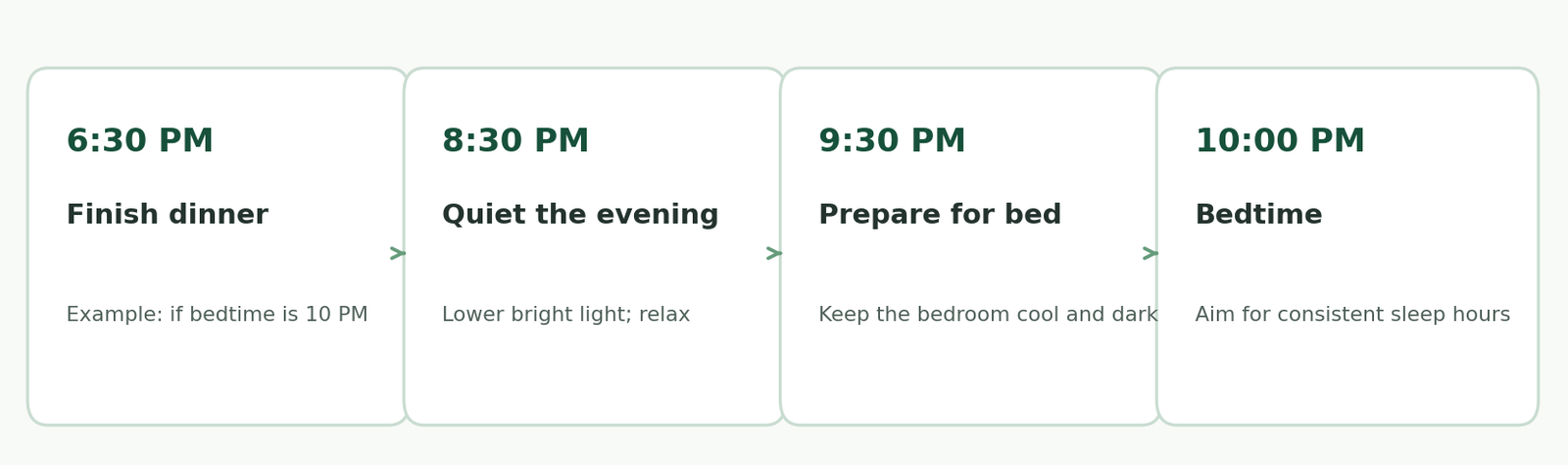
Start with your wake-up time. Choose a bedtime that allows adequate sleep, then aim to keep those hours relatively consistent, including on weekends. During the afternoon and evening, pay attention to caffeine. NIH notes that its effects can last for up to eight hours in some circumstances, so late-afternoon coffee may interfere with nighttime sleep. [7]
In the final hour, dim bright lights, put away work if possible and do something you find calming. A cool, quiet, dark bedroom helps many people sleep more comfortably. Alcohol may make someone sleepy initially, but it can lead to lighter, more disrupted sleep later in the night. Regular daytime activity is helpful too. None of these habits requires buying an expensive sleep product. [7,8]
What if you do all this and still wake up tired?
Sleep difficulties are not always caused by bad habits. Loud snoring, gasping or breathing pauses during sleep, persistent insomnia and excessive daytime sleepiness can point to a sleep disorder. If you consistently get enough time in bed but still struggle to function during the day, speak with a healthcare professional rather than relying on a supplement, sleep-tracking score or stricter bedtime rule.
It is also worth avoiding the pressure to achieve “perfect” sleep every night. A disrupted night happens. What matters more is how regularly you can protect enough time for sleep and whether an ongoing problem needs assessment.
The takeaway
You cannot force the body to recover faster with a single trick. Sleep supports memory, physical recovery, emotional regulation and metabolic health through processes that unfold across the night. Giving yourself enough time to sleep, keeping a reasonably consistent schedule and avoiding heavy meals immediately before bed are sensible places to start. The two-to-three-hour dinner gap may be especially useful if you experience nighttime reflux, but it should be treated as flexible guidance rather than a law of human biology.
Good sleep advice should make everyday life easier, not turn bedtime into another test you can fail.
Common questions about sleep
How many hours of sleep do I need?
The CDC recommends at least seven hours a night for adults aged 18 to 60, seven to nine hours for ages 61 to 64, and seven to eight hours for adults aged 65 and older. Individual needs vary, and sleep quality matters alongside the total time.
Does eating late at night ruin your sleep?
Not for everyone. A gap between a large dinner and bed helps some people, and it matters most if you have reflux. Research has not proven a single cutoff that every healthy adult must follow, and a light snack is usually fine if you are genuinely hungry.
What is the simplest way to sleep better?
Start by giving yourself enough time for sleep and keeping fairly consistent hours, including on weekends. A cool, quiet, dark bedroom, limited late caffeine and regular daytime activity help many people sleep better without any special product.
Why do I still feel tired after enough sleep?
If you regularly spend enough time in bed but still struggle during the day, that can point to a sleep disorder such as sleep apnoea or persistent insomnia. Loud snoring, breathing pauses or heavy daytime sleepiness are reasons to speak with a healthcare professional.
Research and references
- Lager K. MåBra (4 August 2026). “Det här händer i kroppen när du sover (och när du inte gör det).” Original Swedish interview featuring sleep researcher John Axelsson. mabra.com
- National Heart, Lung, and Blood Institute. How Sleep Works: Sleep Phases and Stages. nhlbi.nih.gov
- Effects of sleep restriction on metabolism-related parameters in healthy adults: a comprehensive review and meta-analysis of randomized controlled trials (2019). pubmed.ncbi.nlm.nih.gov
- Tasali E, et al. Effect of sleep extension on objectively assessed energy intake among adults with overweight: a randomized clinical trial (2022). pubmed.ncbi.nlm.nih.gov
- Katz PO, et al. ACG Clinical Guideline: Diagnosis and Management of GERD (2022). pmc.ncbi.nlm.nih.gov
- Effects of later dinner timing on subsequent metabolic function and nocturnal sleep in healthy young women (2026). pubmed.ncbi.nlm.nih.gov
- National Heart, Lung, and Blood Institute. Healthy Sleep Habits. nhlbi.nih.gov
- Centers for Disease Control and Prevention. About Sleep. cdc.gov
Medical note: This article is for general information and does not replace individualized medical advice.

One thought on “How to Recharge Your Body While You Sleep”