
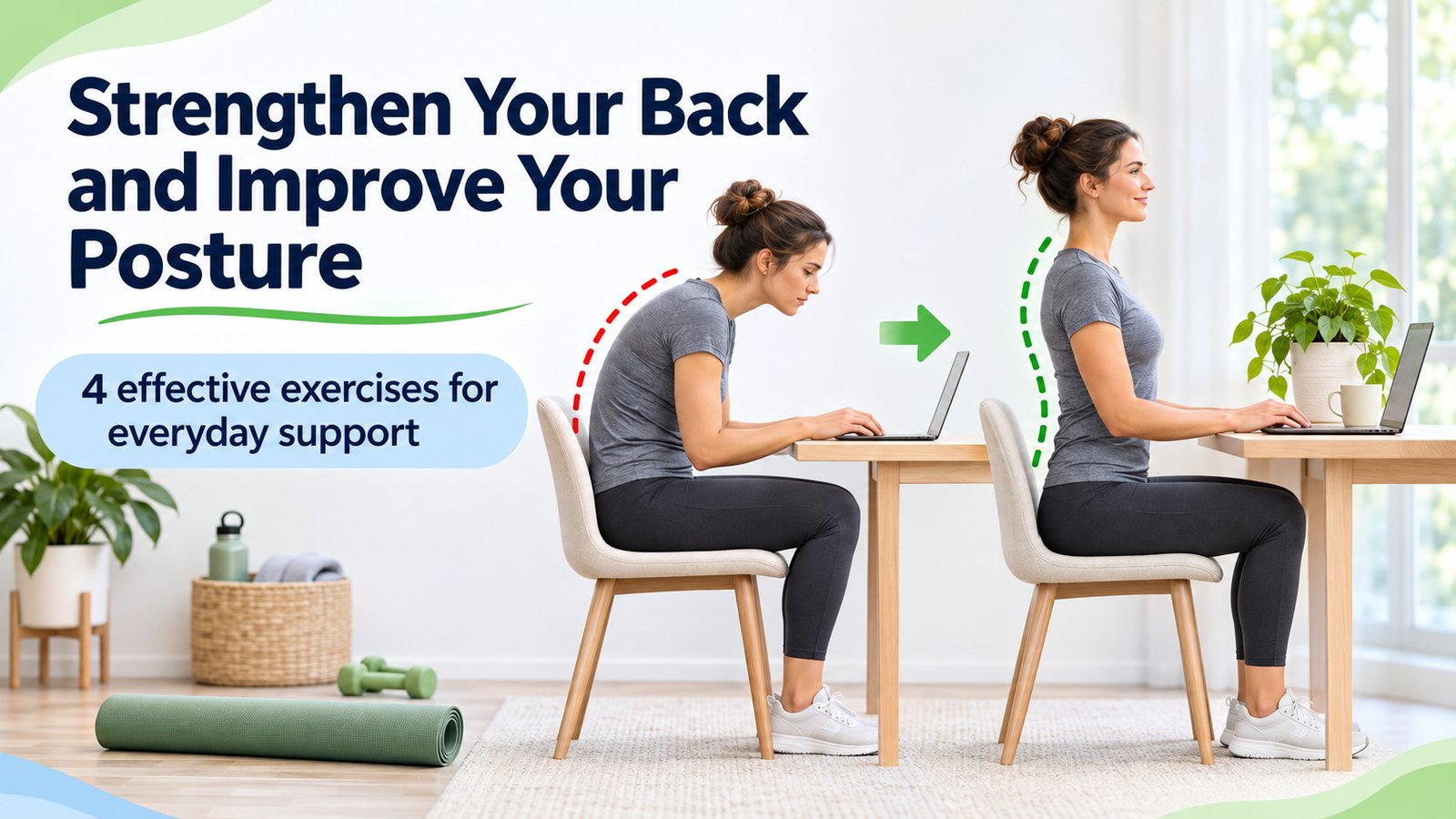
A practical, research-informed set of back exercises for posture and everyday comfort, four simple moves with clear instructions and beginner-friendly adjustments.
After a long day at a desk, you may notice that your shoulders feel stiff or that you keep shifting in your chair to get comfortable. It is tempting to blame every ache on “bad posture.” But our backs are designed to move, and there is no single sitting or standing position that every body must maintain. What often helps is having enough strength, movement options and confidence to change positions throughout the day. [1, 2]
The four exercises below target different parts of that picture. Bird-dog trains control through the trunk. Wall angels invite the shoulders and upper back to move. Glute bridges strengthen the hips and posterior chain. A gentle prone back extension, often called a superman hold, can challenge the back extensors, although it is not suitable for everyone. You only need floor space, a mat and a wall.
Can exercise really improve posture?
Some research suggests it can improve measurable aspects of alignment. A 2024 systematic review and meta-analysis included 23 controlled studies with 969 participants. It found that strengthening programmes were associated with improvements in some postural measures, particularly around the neck and upper back. The results were less convincing for the lower-back and pelvic measures, and the included programmes were not identical to this four-move routine. [3]
Posture and back pain also need to be kept separate. An umbrella review of 41 systematic reviews did not establish that a particular sitting or spinal position causes low-back pain. That does not mean position never matters to how you feel; rather, it means that simply “sitting straight” cannot be presented as a cure. [2]
For people with chronic low-back pain, structured exercise is one of the options recommended in the World Health Organization’s 2023 guidance. A Cochrane review found that exercise probably improves pain compared with no treatment or usual care, although the average gains are not dramatic and no single exercise is best for everybody. This is evidence for exercise programmes as a whole, not proof that the four moves below treat a particular diagnosis. [4, 5]
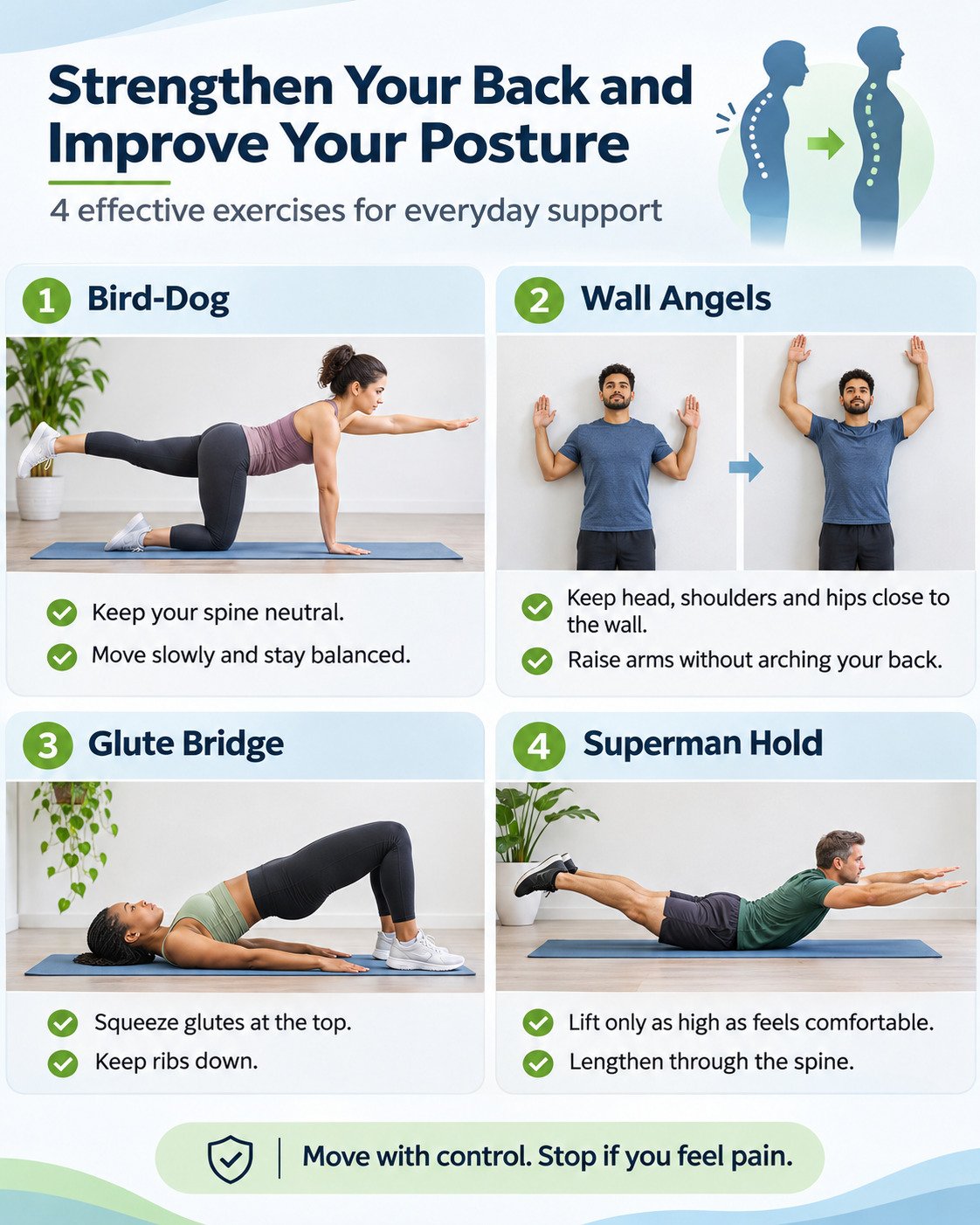
1. Bird-dog: build control through your back and core
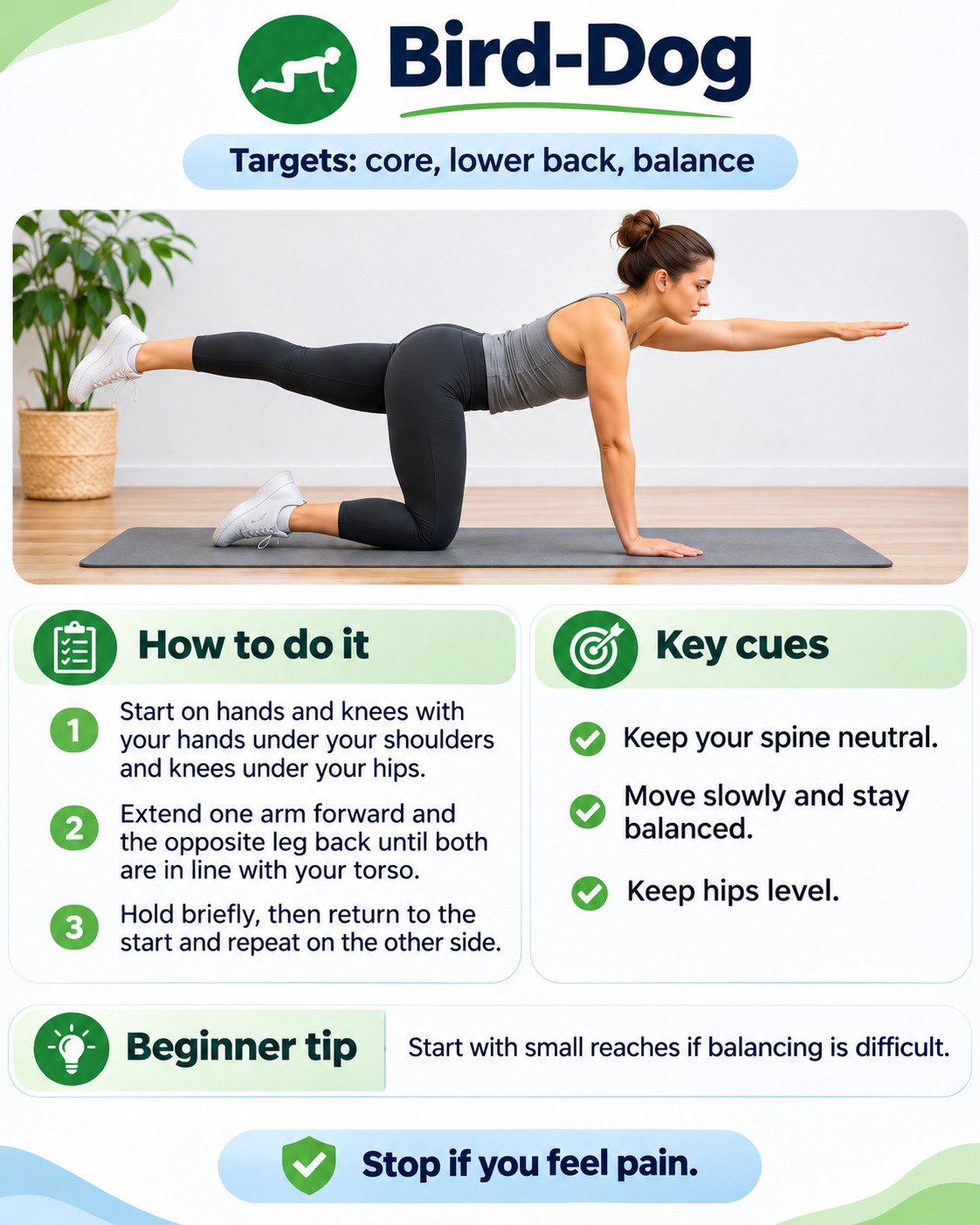
If balancing on one leg feels awkward, bird-dog is a useful reminder that stability starts with controlled movement, not a rigid spine. The American Academy of Orthopaedic Surgeons includes it in its spine-conditioning programme and identifies the back extensors and gluteal muscles among the muscles involved. [6]
How to do it
Start on your hands and knees, with wrists under shoulders and knees under hips. Gently brace your abdominal muscles. Reach one arm forward and extend the opposite leg behind you, only as far as you can while keeping your hips reasonably level. Pause for three to five seconds, then return slowly and switch sides.
Beginner starting point: Try 5 controlled repetitions on each side. If balance is difficult, move just one arm or one leg at a time before combining them. The suggested count is a starting option, not a proven therapeutic dose.
Common mistake: Letting your lower back arch or twisting your pelvis in an effort to raise the leg higher. Smaller, steadier movements are more useful than a big reach.
2. Wall angels: get your upper back and shoulders moving
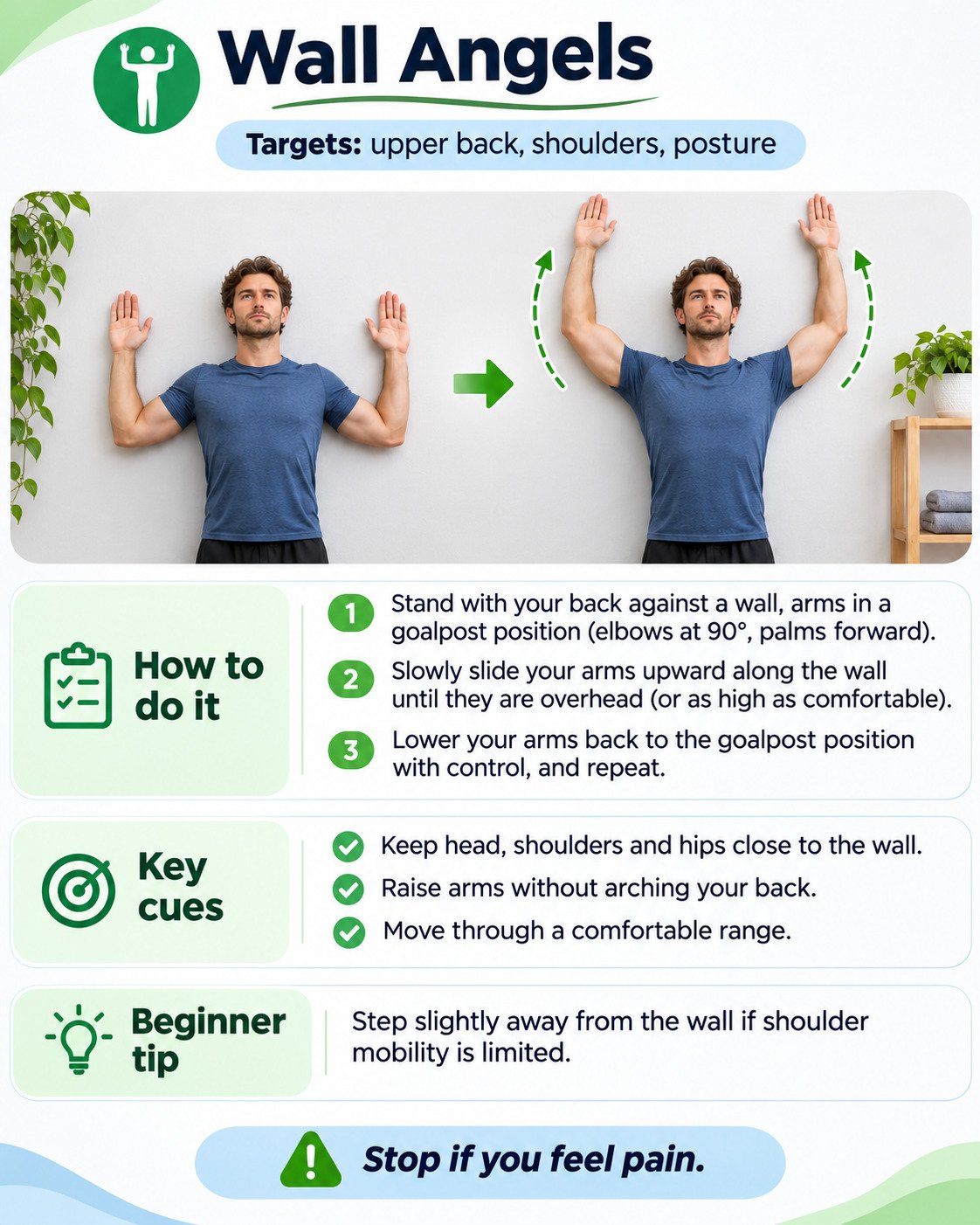
Wall angels are often recommended for people who spend a lot of time at a computer. They involve lifting the arms while trying to keep the ribs and trunk from compensating. Cleveland Clinic includes wall angels among exercises that may help people work on posture and shoulder movement. [7]
How to do it
Stand with your back facing a wall and feet slightly forward if that is more comfortable. Raise both arms into a goalpost shape. Slowly slide them upward, then lower them again. Keep breathing and avoid forcing your ribs upward or arching your lower back to gain extra height. A little distance between parts of your body and the wall is fine.
Beginner starting point: Try 6 to 8 slow repetitions. Stop before you reach a painful shoulder position, and make the movement smaller if you feel pinching.
Common mistake: Turning the movement into a test of how flat you can press your body against the wall. The goal is comfortable shoulder motion, not to make every part of your back touch.
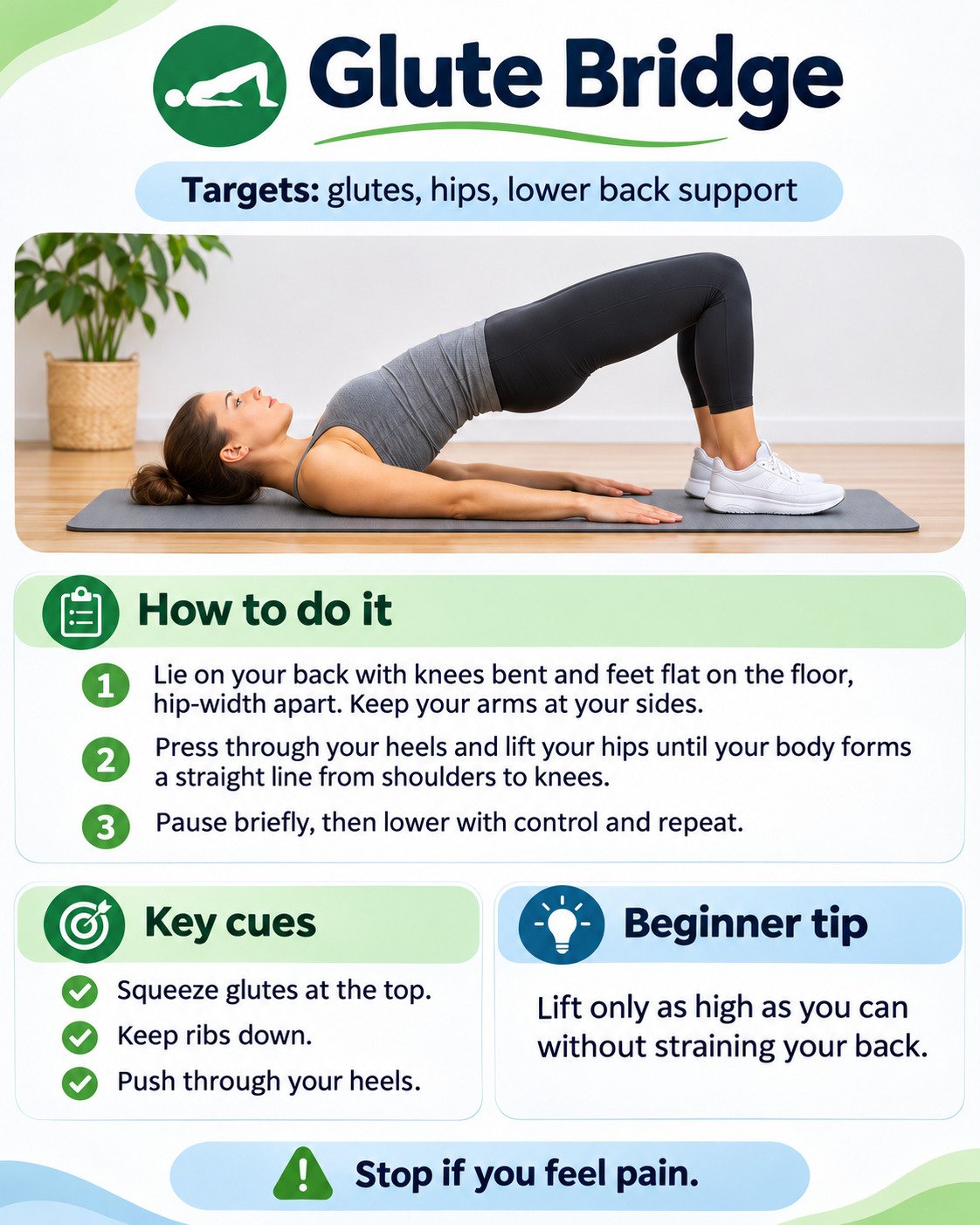
Your lower back does not do everything alone. The muscles around the hips help control movements such as standing from a chair, climbing stairs and lifting objects. A glute bridge trains those muscles while you are supported on the floor. The AAOS also includes a hip bridge in its spine-conditioning programme. [6]
How to do it
Lie on your back with knees bent and feet flat about hip-width apart. Let your arms rest by your sides. Tighten your buttocks and lift your hips slowly, aiming for a comfortable line from shoulders to knees. Pause for a moment without holding your breath, then lower with control.
Beginner starting point: Try 8 repetitions, with a short pause at the top. If your hamstrings cramp, bring the feet a little nearer or reduce the height of the lift.
Common mistake: Pushing the hips so high that the lower back bends sharply. The movement should come primarily from the hips and gluteal muscles.
4. Gentle superman hold: optional work for the back extensors
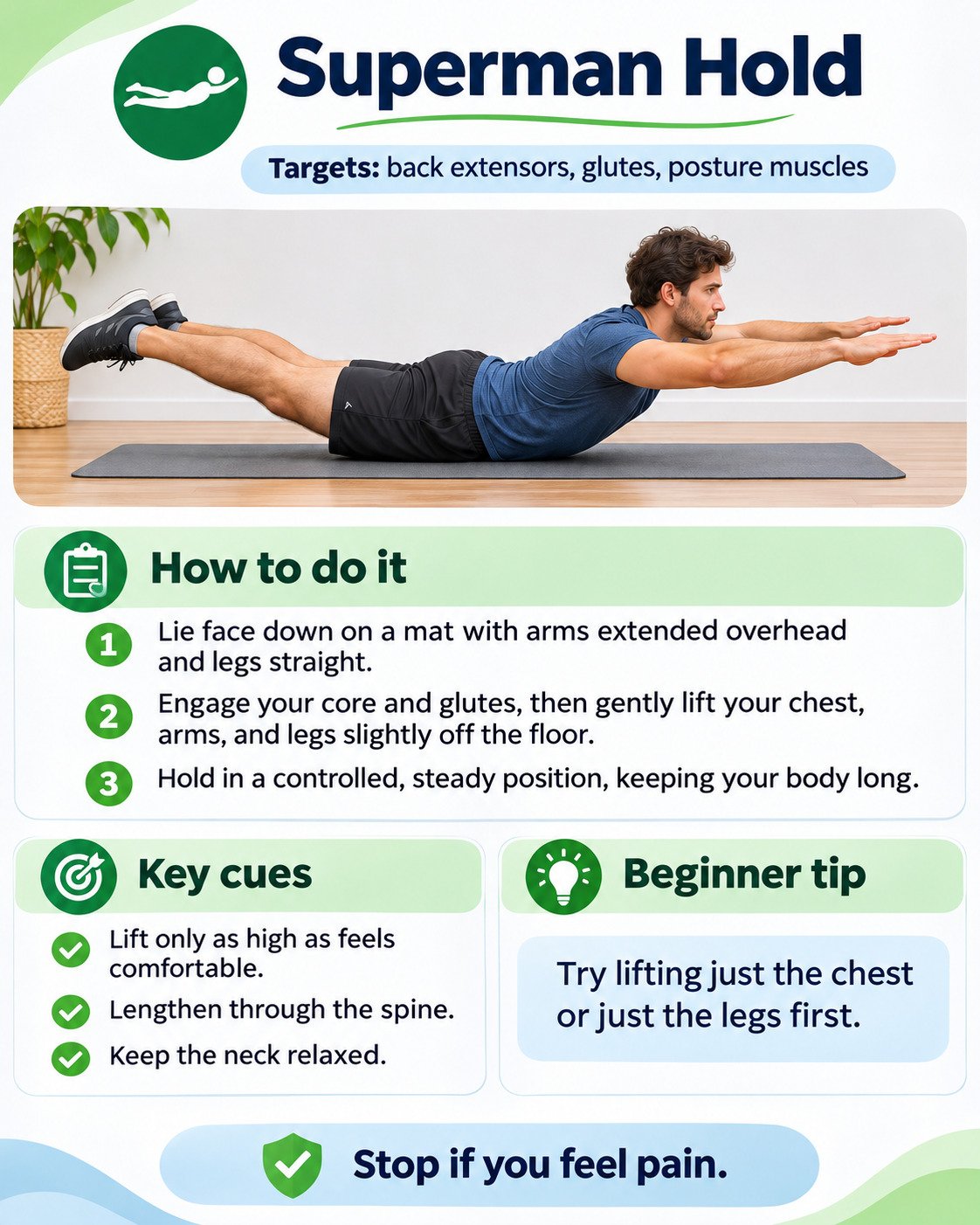
A superman hold challenges the muscles that help extend the back. It is also the move in this routine that deserves the most caution. Some people find prone extension comfortable; others, especially people whose symptoms worsen when bending backward, do not. There is no reason to push through pain to complete a list of four exercises.
How to do it
Lie face down on a mat and look toward the floor to keep your neck comfortable. Gently engage your abdominal and gluteal muscles. Lift your hands and chest only slightly off the floor, then lower again. You can begin with the chest alone or with one arm at a time. Lifting both legs is optional and should be skipped if it strains the lower back.
Beginner starting point: Try 3 to 5 gentle lifts lasting two or three seconds each. Stop if the move creates or worsens back pain. If it does not suit you, leave it out and focus on the other exercises or seek a physiotherapist’s alternative.
Common mistake: Throwing the arms and legs upward to make the shape more dramatic. A small, controlled range is enough to make the muscles work.
A realistic routine you can actually keep doing
You do not need a complicated 45-minute programme to begin. On two or three non-consecutive days each week, do a short round of the movements you can perform comfortably. One set of each is enough to learn the technique. When the routine starts to feel easier, you may add a second set, slow the movement or increase repetitions gradually. These are general starting suggestions, not a prescription for someone recovering from injury.
| Exercise | Simple starting dose | Main focus |
|---|---|---|
| Bird-dog | 5 each side | Trunk control |
| Wall angels | 6–8 | Shoulder movement |
| Glute bridge | 8 | Hip strength |
| Gentle superman | 3–5 (optional) | Back extensors |
The counts above are deliberately conservative examples. The best range depends on your health, current fitness, symptoms and the quality of each repetition.
On other days, walking and changing position periodically may be more helpful than spending the whole afternoon trying to sit perfectly straight. Think of posture as a range of positions you can move between, not a single pose you must freeze in. [1, 2]
When these exercises are not the right starting point
If you have a recent injury, spinal surgery, osteoporosis with fracture risk, worsening nerve symptoms, or back pain that clearly increases during a particular movement, ask a clinician or physiotherapist which exercises are appropriate. Seek urgent medical assessment for new bladder or bowel control problems, numbness around the groin or saddle area, or new significant weakness or numbness in both legs. [8]
You may also need a more tailored plan if you already have persistent pain. The WHO advises that chronic low-back care should consider physical, psychological and social factors and may require several types of support. A four-exercise routine cannot replace an assessment when symptoms are ongoing or severe. [4]
What progress might look like
After several sessions, the first improvement may simply be that the movements feel less awkward. You might balance more steadily during bird-dog, lift your arms more comfortably during wall angels or rise from a chair with better awareness of your hips. Those are useful signs of practice, even if you notice no visible change in how you stand.
Give yourself time to build consistency and keep the goals practical. The aim is not to look permanently upright in a photograph. It is to have a stronger back, more movement choices and fewer reasons to avoid ordinary activities.
Frequently asked questions
Can these four exercises fix rounded shoulders?
They may help strengthen or move some of the muscles involved, but there is no guarantee they will change your appearance. Posture varies naturally, and the research on strengthening includes many different programmes rather than this exact four-exercise combination. [2, 3]
Should I do the routine every day?
It is fine to begin with two or three days a week and see how your body responds. Gentle movement on other days is useful too. If you have a rehabilitation plan from a clinician, follow that plan instead of this general schedule.
What if I feel back pain during a superman hold?
Stop that movement. Try a smaller, supported alternative only if it is comfortable, or skip it. Pain is not a requirement for gaining strength. Seek professional advice if symptoms persist or worsen.
Is sitting upright all day better than slouching?
Not necessarily. A comfortable, supported position and regular changes of position are sensible goals. There is no good evidence that holding one supposedly perfect posture all day prevents back pain. [1, 2]
The takeaway
Your back does not need to be held in one exact position all day. It needs the opportunity to move and the capacity to handle daily demands. Start with a few careful repetitions, notice which exercises feel useful and keep building from there. If your goal is less discomfort rather than a particular appearance, that is a very good reason to begin.
Research and sources
- Northamptonshire Healthcare NHS Foundation Trust. Facts about posture and back pain. (Open access)
- Swain CTV et al. No consensus on causality of spine postures or physical exposure and low back pain. Journal of Biomechanics (2020). (Open access)
- Warneke K et al. Effects of stretching or strengthening exercise on spinal and lumbopelvic posture: a systematic review and meta-analysis (2024), 23 studies, 969 participants. (Open access)
- World Health Organization. WHO guideline for non-surgical management of chronic primary low back pain in adults (2023). (Open access)
- Hayden JA et al. Exercise therapy for chronic low back pain. Cochrane Database of Systematic Reviews (2021). (Open access)
- American Academy of Orthopaedic Surgeons. Spine Conditioning Program: bird-dog and hip bridge instructions. (Open access)
- Cleveland Clinic. 8 Posture Exercises To Sit and Stand Straighter (2024). (Open access)
- National Health Service. Back pain: when to seek urgent or emergency care. (Open access)
Evidence note. The cited reviews support general exercise and selected posture outcomes; none specifically proves that this exact four-move routine prevents injury or cures back pain. Exercise illustrations are newly generated and not photographs of clinically supervised demonstrations. Repetition ranges are general beginner suggestions, not individualized medical prescriptions.
Health disclaimer. This article is educational and cannot replace diagnosis, physiotherapy advice or medical care. Stop any exercise that worsens symptoms.

One thought on “Strengthen Your Back and Improve Your Posture: 4 Effective Exercises”